Böhler N690 Steel: Composition, Hardness and Real-World Performance
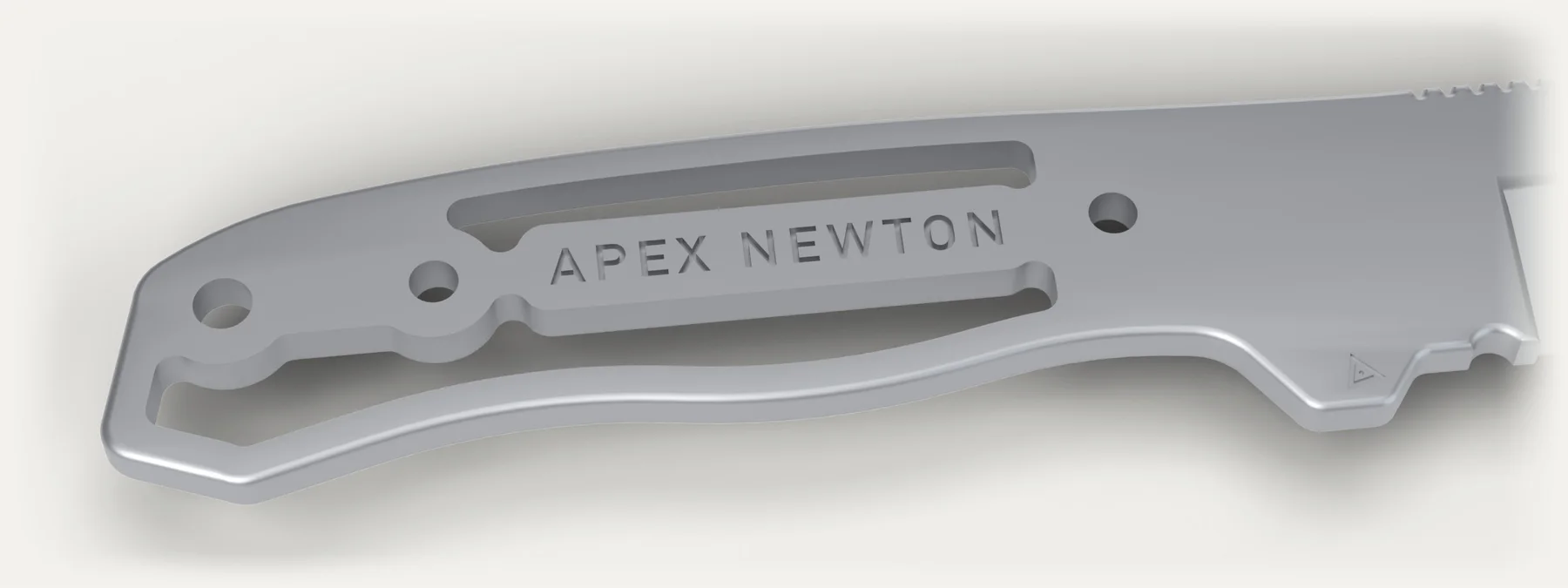
Böhler N690 is one of the most widely used premium stainless knife steels in Europe. It comes from Böhler Edelstahl in Kapfenberg, Austria, part of the voestalpine group. If you have handled a serious European fixed blade, there is a good chance it was N690. Here is what is actually in it, what it does well, and how we use it in the APEX NEWTON Core.
What N690 is made of
Böhler’s datasheet gives the following composition in weight percent:
| Element | % | What it does |
|---|---|---|
| Carbon (C) | 1.08 | Makes hardening possible; forms hard carbides |
| Chromium (Cr) | 17.3 | Corrosion resistance; also forms carbides |
| Molybdenum (Mo) | 1.1 | Pitting resistance, strength |
| Cobalt (Co) | 1.5 | Strengthens the steel matrix |
| Vanadium (V) | 0.1 | Fine grain |
| Silicon (Si) | 0.4 | Deoxidiser, strength |
| Manganese (Mn) | 0.4 | Hardenability |
Böhler classifies it as a martensitic, corrosion-resistant chromium steel and approves it for food contact. Cobalt is the unusual ingredient. Few stainless knife steels contain it, and it is the reason N690 is sometimes sold as N690Co.
How hard does N690 get?
Böhler hardens N690 at 1030 to 1080 °C, quenches it, and tempers it at 100 to 200 °C. Done that way, the datasheet lists achievable hardness up to 59 to 61 HRC. Most production knives in N690 land between 58 and 60 HRC.
Edge retention, toughness and corrosion
Böhler rates N690 qualitatively rather than with test numbers:
- Wear resistance: very high
- Corrosion resistance: high
- Toughness and ductility: good
- Polishability: good
In practice that means an edge that lasts through a lot of cardboard, rope and food, a blade that does not rust overnight after rain or blood, and enough toughness for outdoor use. With 17.3 % chromium it sits well above the roughly 13 % usually cited as the threshold for stainless steel.
Is N690 hard to sharpen?
Sources disagree, and the honest answer depends on hardness. At the top of its range N690 resists abrasion, which is exactly what wear resistance means. At 58 HRC it takes a fine edge on diamond or ceramic stones and comes back quickly with a strop. Most owners will only need a ceramic rod for touch-ups.
Why we run it at 58 HRC
Hardness and toughness pull in opposite directions. A harder blade holds its edge longer but is more likely to chip under side load. A slightly softer blade rolls instead of chipping, and a rolled edge can be straightened in a few strokes.
The Core is a 5.0 mm, full-tang outdoor knife that will be used for batoning, carving and food. We would rather give up one point of hardness than risk a chipped edge in the field, so we specify 58 HRC.
N690 vs other stainless knife steels
N690 is often compared to Böhler’s own N695 (similar chromium, no cobalt) and to 440C (similar carbon and chromium, no cobalt). The cobalt and molybdenum content is what separates N690 from those two. Powder-metallurgy steels such as M390 hold an edge longer, but they cost more and are harder to sharpen in the field. For a hard-use outdoor blade, N690 sits in a sweet spot: tough, stainless and easy to maintain.
The short version
- Austrian stainless steel from Böhler, with cobalt and molybdenum
- Up to 59–61 HRC possible; we use 58 HRC for toughness
- Very high wear resistance, high corrosion resistance, good toughness
- Food-contact approved
See how it is used in the Core.