Full Flat Grind Explained: Why Blade Geometry Matters More Than Steel
Two knives in the same steel can cut completely differently. The reason is geometry: how the blade thins from the spine down to the edge. The grind is that transition, and it matters more for everyday cutting than which premium steel you pick.
What is a full flat grind?
On a full flat grind, the blade tapers in a straight line on both sides from at or near the spine all the way to the edge. Seen in cross-section, the blade is a long, slim wedge.
Other common grinds:
- Saber grind: flat bevels start lower, often halfway down the blade, leaving a thick, full-height section above. Strong, but wedges in thick material.
- Scandi grind: one wide, low bevel straight to the edge with no secondary bevel. Excellent for wood carving, harder to maintain on some steels.
- Hollow grind: concave bevels. Very thin behind the edge, slices well, less robust laterally.
- Convex grind: curved bevels. Strong edge, slices well, harder to resharpen at home.
Grind height and edge thickness
Two numbers describe how a blade will cut:
- Where the grind starts. The higher it starts, the gentler the taper and the less the blade wedges apart what it cuts.
- Thickness behind the edge. The thinner the steel just above the sharpened edge, the less force it takes to push through material.
Thick stock is good for strength, but thick stock with a low grind cuts like a splitting wedge.
The Core’s geometry
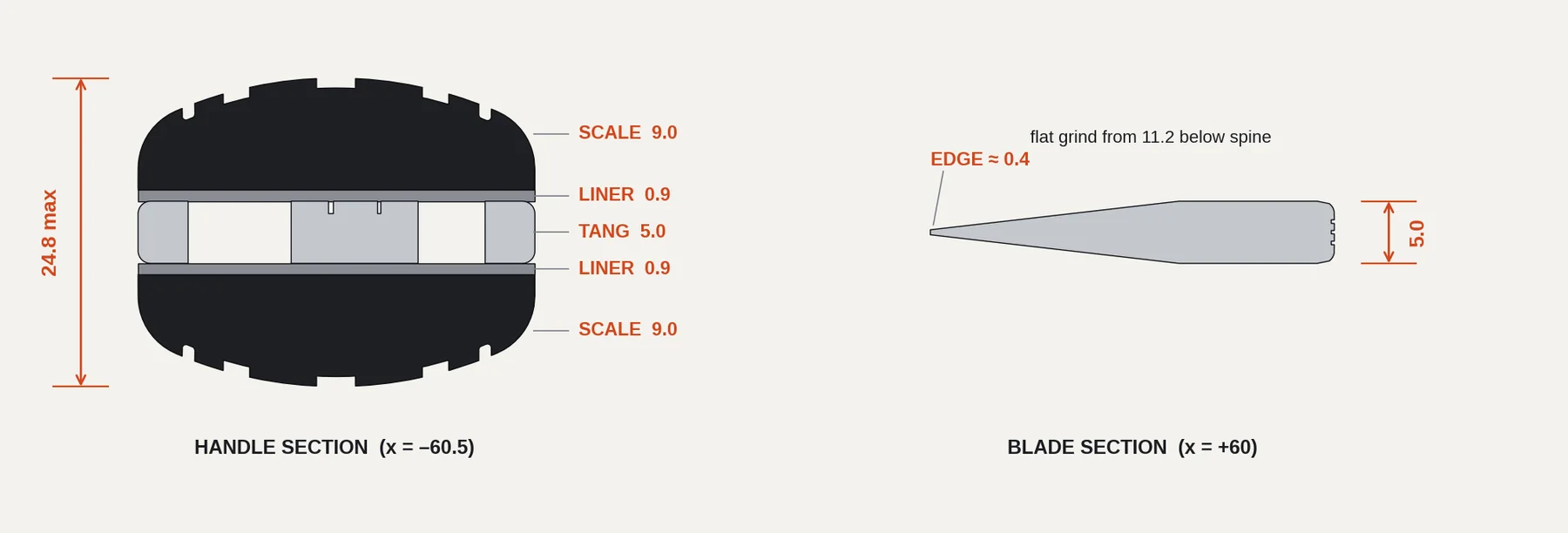
The APEX NEWTON Core uses 5.0 mm stock for strength and a full flat grind for cutting:
| Core | |
|---|---|
| Stock | 5.0 mm |
| Grind | Full flat |
| Grind starts | 11.2 mm below the spine |
| Thickness behind the edge | 0.4 mm |
| Blade height | 32.5 mm |
| Cutting length | 126.9 mm |
That means a full 5.0 mm spine where you need strength, for batoning or pushing with the thumb, and a thin edge where you need cutting performance. It is the reason a heavy outdoor knife can still slice a tomato.
How it is made
The Core’s profile is laser-cut from N690 plate, machined to shape, and the flat bevels are ground in afterwards. The spine is left flat with radiused edges and jimping for the thumb.
See the blade section of the Core.